
What "renovation" usually covers
People use the word to mean anything from a tidy-up to a complete rebuild. In our work it normally means changing most of the garden in one planned project: clearing what is there, reshaping the levels, laying new hard surfaces, putting in a lawn or planting, renewing the boundaries and perhaps adding a structure. Because it combines so much, the budget is really a collection of smaller budgets, each covered below.
Clearance and waste
Before anything new goes in, the old has to come out. Overgrown shrubs, tired paving, broken sheds, old concrete bases and rubble all need removing, and most of it has to leave the site. The volume of waste is often bigger than people expect, and it can be a meaningful share of the total, especially in gardens where access is through the house.
Levels, steps and drainage
Sloping gardens rarely feel usable until they are broken into flatter areas, which means moving soil, building retaining edges and adding steps. Getting water to drain away from the house and off patios is just as important, and gardens on heavy soil may need channels or a soakaway. This work is mostly hidden once finished, yet it is often where a renovation budget goes first.
Hard landscaping: patios, paths, walls
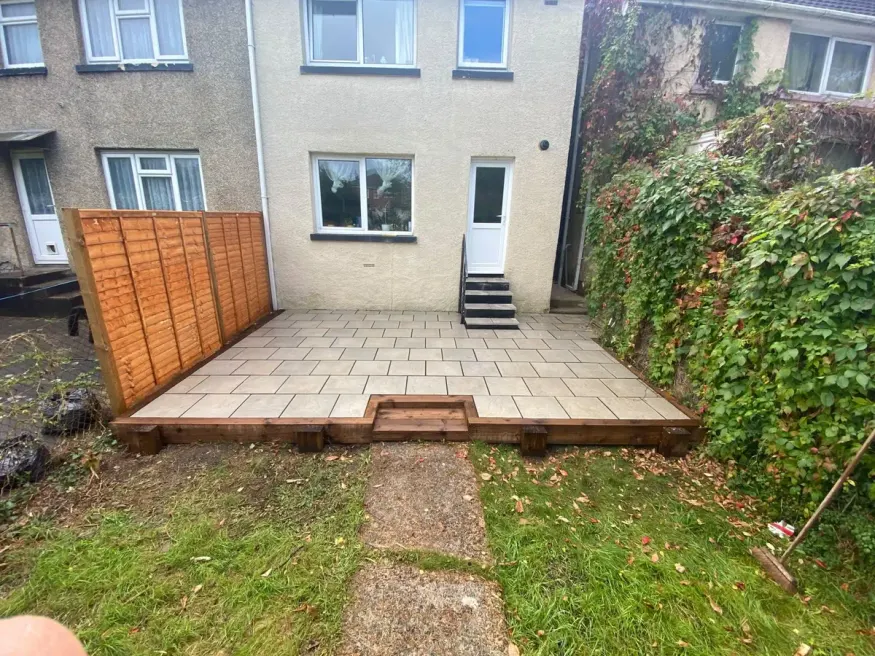
Paving is usually the largest single element. The size of the patio, the slab chosen, the depth of the base and the number of cuts all play a part, as our patio cost guide explains. Paths, raised beds, brick walls and edging add to the hard landscaping total. Choosing materials that match each other across the garden helps the finished result look planned rather than pieced together.
Soft landscaping: lawns and planting
Lawns and planting are generally less costly than paving per square metre, but they still depend on good ground preparation. Turf needs levelled, improved soil, and planting beds benefit from fresh topsoil. Artificial grass sits between the two, needing a built stone base but very little upkeep afterwards.
Fencing and boundaries
New boundaries frame the whole garden and are best fitted early, before lawns and paving are finished. The length of the boundary, the fence style and whether old fences need removing all shape this part of the budget. Our fencing page covers how a new boundary is built.
Structures: pergolas and seating areas
A pergola, covered seating area or built-in bench gives the garden a focal point and somewhere to spend time. Structures are often the element people choose to add later if the budget is tight, so it helps to plan their position and any fixing points at the start. See our pergolas page for examples.
Phasing a renovation over two seasons
Not every renovation has to happen at once. A sensible way to spread the cost is to design the whole garden first, then build it in an order that protects finished work. The first phase usually covers clearance, levels, drainage, paving and boundaries, since these involve heavy machinery and materials. The second phase can add the lawn, planting and any structures. Splitting the job like this does add some repeated setting-up time, but it lets you budget across two seasons without compromising the final design.
Our garden renovations page explains how a full project runs, and our projects gallery shows real before-and-after transformations.
Frequently asked questions
What takes up most of a garden renovation budget?
In most gardens it is the hard landscaping, particularly the patio, along with the groundwork beneath it. Levels, drainage and waste removal can also take a large share, even though they are hidden once the garden is finished.
Can a garden renovation be done in stages?
Yes. Planning the whole design first and then building the groundwork, paving and boundaries before the lawn, planting and structures lets the cost be spread without having to redo anything.
Is it cheaper to keep my existing patio?
It can be, if the patio is solid, drains well and suits the new layout and levels. If it is sinking, poorly drained or in the wrong place, keeping it can limit the design and lead to costs later.
Why does drainage add to the cost?
Drainage can involve digging channels, laying pipes or building a soakaway, plus extra materials and waste. It costs far less to include at the start than to fix flooding or standing water afterwards.
How long does a full garden renovation take?
It depends on the size of the garden, the amount of groundwork and the elements involved. Daniel can give a realistic timescale once he has seen the site and agreed the plan with you.