
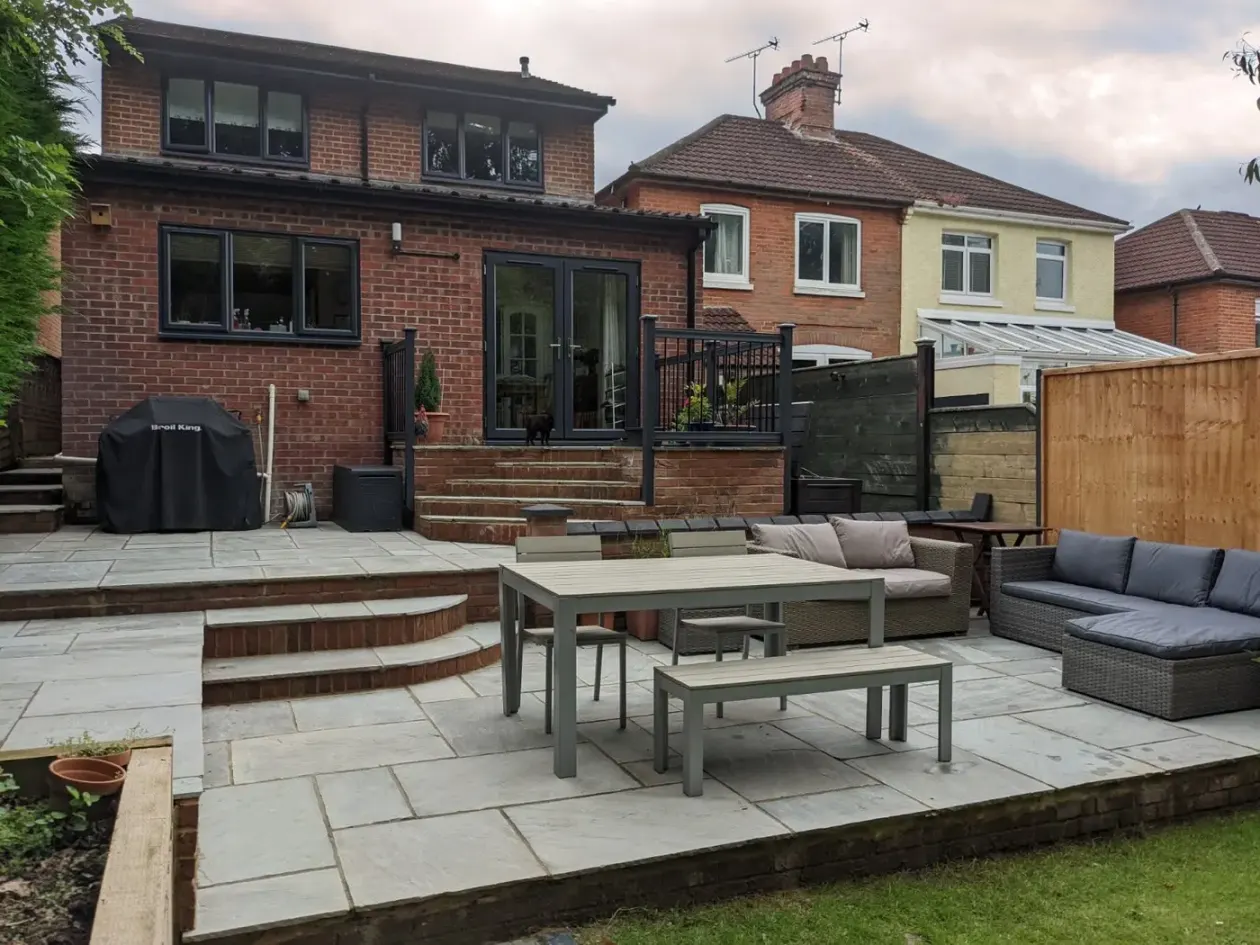
Patios are at the heart of what we do
Patios are one of the two areas Daniel John Landscapes focuses on most, alongside full garden renovations. A well-built patio is the part of a garden people use every day: it is where the table goes, where the barbecue lives and where you step out of the back door first thing in the morning. Getting it right matters more than almost any other part of an outdoor project.
Based in Sholing, Daniel has 18 years of trading experience and works across Southampton, Eastleigh, Romsey, Winchester, Portsmouth and the New Forest. You can see a range of finished paving in our projects gallery, from large-format porcelain terraces to split-level sandstone with brick steps.
What happens beneath the slabs
Most patio problems start underground. Slabs that rock, sink or crack, and puddles that sit against the house, nearly always trace back to poor preparation. That is why the visible finish is only the last stage of the job.
A typical installation begins by marking out the area and digging down to firm ground. Soft spots, roots and old rubble are removed. A compacted sub-base of crushed stone is then built up in layers, giving the patio a stable platform that will not shift with the seasons. The slabs are bedded on top, with joints filled to suit the material chosen.
- Excavation to a suitable depth for the ground conditions
- Compacted sub-base built in layers
- Full bedding of each slab to avoid hollow spots
- Pointing or jointing matched to porcelain or natural stone
Levels, falls and drainage
A patio should never be perfectly flat. It needs a gentle fall so that rainwater runs away from the house and into the garden, a soakaway or a drainage channel. The fall is set before any slab is laid and checked repeatedly as the work progresses.
Patios laid next to a building also need to sit at the right height in relation to the damp-proof course and any air bricks. Where a garden slopes, we can create raised areas, retaining walls or steps so that each level is usable. The split-level and raised terraces in our gallery show how a sloping plot can become two or three distinct spaces.
Choosing between porcelain and natural stone
Porcelain is dense, consistent and resistant to staining, which makes it popular for modern homes and for anyone who wants an easy surface to keep clean. Large-format porcelain slabs give a crisp, contemporary look with fewer joints.
Natural stone such as sandstone has variation in colour and texture that many people love, and it suits traditional and cottage-style gardens. It needs a slightly different laying approach and benefits from the right sealing and aftercare. Slate offers a darker, more dramatic finish. We talk through the pros and cons of each on site so you can choose with confidence.
Steps, edging and finishing details
The details are what make a patio feel finished. Brick or block edging, curved borders, sleeper surrounds, raised planters and wide steps all change how a space looks and works. Several of our completed jobs combine paving with brick-built features such as raised beds, curved walls and even raised ponds.
If your patio is one part of a bigger plan, it can be combined with a new lawn, artificial grass, fencing or a timber pergola, so that everything is built in the right order by one team.
Planning your budget
Every patio is priced on its own merits, because area, access, ground conditions, levels and the slab you choose all vary from garden to garden. Our patio cost guide explains each of these factors in plain English so you know what to expect before we visit.
Patio repairs and relaying
Not every tired patio needs replacing. Slabs that rock underfoot or have sunk in places usually point to a weak or washed-out base beneath them, while crumbling or missing joints let water and weeds in and speed up the problem. Puddles that sit after rain often mean the falls were never right, so water has nowhere to go. Small, isolated faults can be patched by lifting the affected slabs, rebuilding the bedding and re-pointing. When the problems are spread across the whole area, relaying on a new, properly compacted base with correct falls is usually the better choice, and sound slabs can often be cleaned and reused. Daniel will look at the base, the levels and the drainage before suggesting either option, and our guide to what affects patio prices explains how that work is priced.
Looking after your new patio
A well-laid patio needs very little upkeep. Sweeping regularly, removing leaves before they stain and dealing with spills promptly keep it looking fresh. Joints can be checked occasionally and topped up if needed. Natural stone may benefit from the right cleaning products and, in some cases, sealing.
Frequently asked questions
How long does it take to lay a patio?
It depends on the size of the area, the ground conditions and whether steps, walls or drainage are involved. Daniel will give you a realistic timescale once he has seen the site.
Do you lay both porcelain and natural stone?
Yes. Our completed work includes porcelain, sandstone and slate patios. Each material is laid using the method that suits it.
Can you build a patio on a sloping garden?
Yes. Sloping gardens can be split into levels with steps and retaining edges, as shown by the split-level and raised patios in our projects gallery.
Will my new patio drain properly?
Every patio is laid with a gentle fall away from the house, and drainage is planned before the slabs go down.
Can you relay my existing patio slabs?
Often, yes. If the slabs themselves are in good condition, they can be lifted, cleaned and relaid on a new compacted base with proper falls. Cracked or badly worn slabs are replaced.
Which areas do you cover for patio laying?
We are based in Sholing and work across Southampton, Eastleigh, Romsey, Winchester, Portsmouth and the New Forest, travelling up to 30 miles. See areas we cover.