
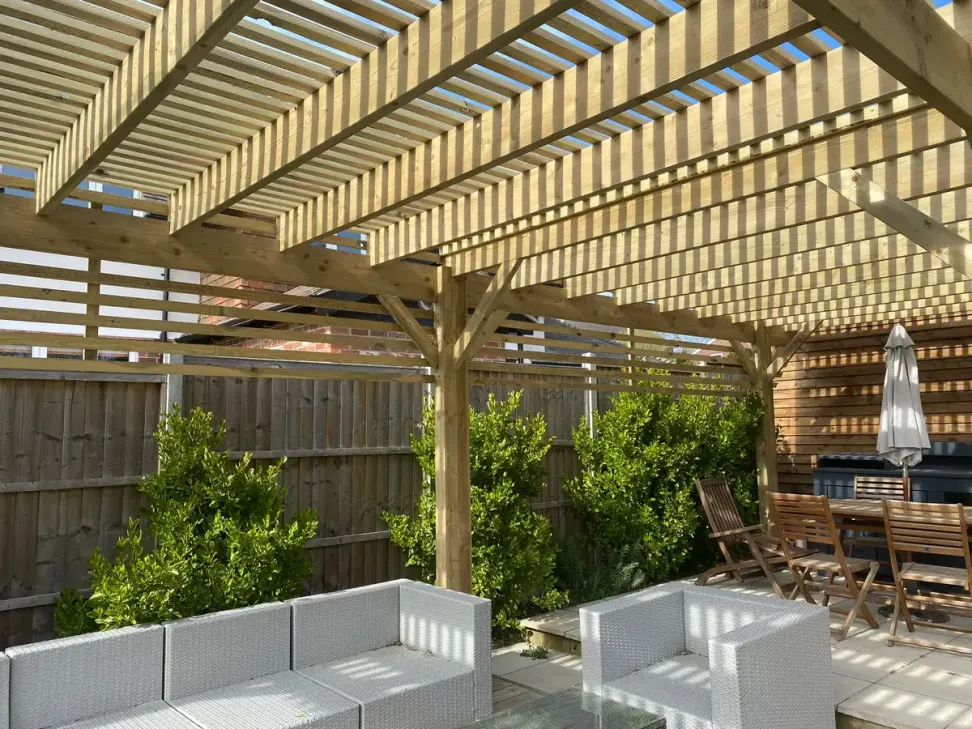
What goes into a pergola price
Every pergola price is a mix of timber, fixings, footings and labour, plus whatever extras turn it from a frame into a usable space. Because a made-to-measure structure is designed around your garden rather than taken from a box, the cost depends on the decisions you make about its size, how it is supported and what goes on top.
Size and layout
The footprint sets how many posts, beams and rafters are needed. Larger spans may call for heavier beams or an extra post so the structure does not sag. An L-shape or a pergola that wraps around a corner involves more joints than a simple square. Height plays a part as well, because taller posts need deeper fixing to stay rigid when the wind gets up.
Timber and finish
Most garden pergolas are built from pressure-treated softwood, which is reliable and good value. Thicker sections give a more substantial look and stiffer frame but cost more. Some people prefer a planed, smooth finish rather than a rougher sawn timber, and staining or painting the frame to match fences or window frames adds time. Decorative details, such as shaped rafter ends, add character and a little more work.
Wall-mounted or freestanding
A pergola fixed to the house uses the wall to support one side, which saves on posts and footings. It does, however, need a sound wall, the right fixings and care around windows, doors and drainpipes. A freestanding pergola needs posts at every corner and must be braced to stand on its own, but it can sit anywhere in the garden, such as over a far seating area or at the end of a lawn.
Footings and ground
Posts are either set into concrete in the ground or bolted to a solid base. On a new patio, fixing points can be planned before the paving goes down. On existing paving, the slabs and their base need to be strong enough to hold the fixings. Soft ground, buried services or a slope can all affect how the posts are secured and how long it takes.
Roof options: open slats or a covering
An open roof of slats or rafters gives dappled shade and leaves room for climbers. Adding a covering, such as clear or tinted roof panels or a fabric canopy, keeps light rain off and lets you use the space more of the year. Coverings need a slight fall so water runs off, and the frame may need extra rafters to support them, so they add to both materials and labour.
Lighting and extras
Festoon lights, wall lights and power points make a pergola usable after dark, but any electrical work needs planning early so cables can be run neatly. Side screens, outdoor curtains, built-in benches and planters are other popular additions. Each is optional, and they can be added later if you would rather keep the first stage simple.
Do you need planning permission for a pergola?
Most garden pergolas are treated as outbuildings or garden structures that can be built without a planning application, provided they stay within size and height limits. Different rules can apply to listed buildings, homes in conservation areas and structures placed close to a boundary, and a covered structure attached to the house may be viewed differently from an open frame. The safest step is always to check with your local council before work begins.
Our pergolas page shows how we build timber structures, and our projects gallery has finished examples. A pergola often sits on a new patio or forms part of a full garden renovation.
Frequently asked questions
Do I need planning permission for a pergola?
Often not, as long as it stays within size and height limits. Listed buildings, conservation areas and structures close to boundaries can be different, so check with your local council before building.
Is a freestanding pergola cheaper than one fixed to the house?
Not always. A wall-fixed pergola needs fewer posts and footings, but it relies on a sound wall and careful fixing. A freestanding one needs posts at every corner and bracing to stand on its own.
Does adding a roof covering change the cost?
Yes. A covering adds roofing material, may need extra rafters to support it and has to be set at a slight fall so rainwater runs off.
How long does a timber pergola last?
It depends on the timber, the exposure and how well it is looked after. Treated timber that is kept clear of standing water and re-treated every few years will last far longer than one left untouched.
Can a pergola go on an existing patio?
It can if the slabs and the base beneath them are firm enough to take the post fixings. If they are not, the posts may need their own footings cut through the paving.