
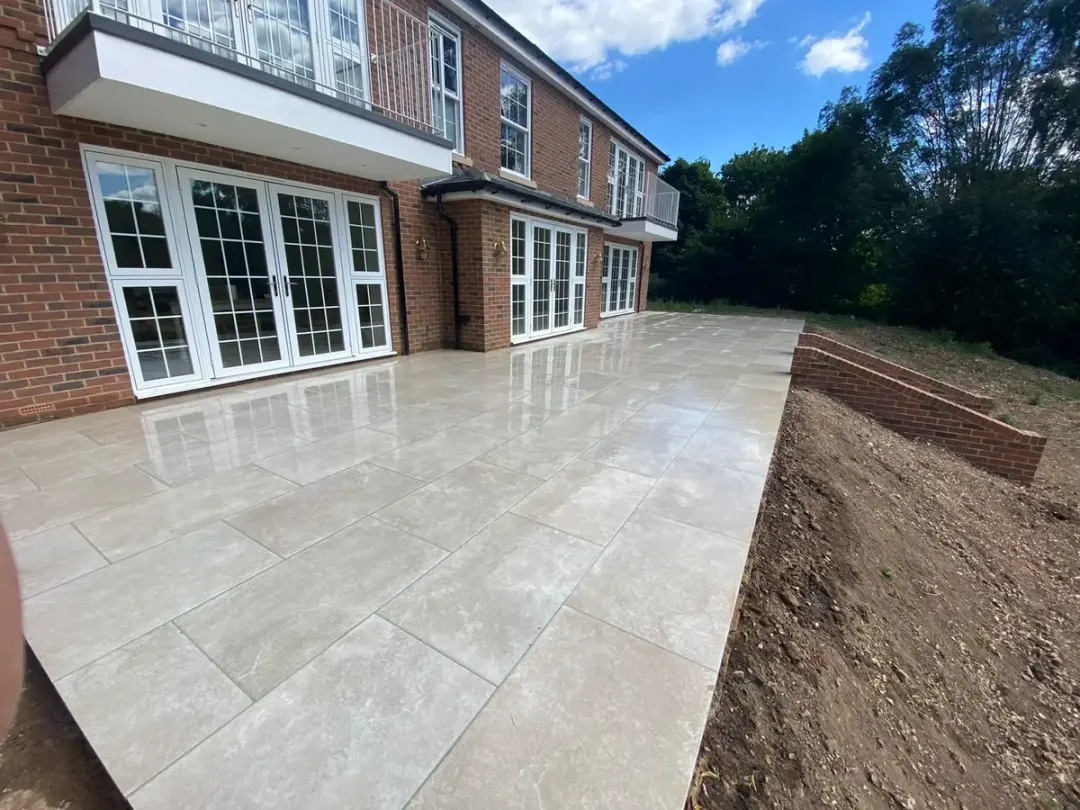
Why there is no single price
Ask ten people what their patio cost and you will get ten very different answers. Two patios of the same size can differ widely in price because of what sits beneath them, how easy the site is to reach and how the finished space is shaped. That is why we price each patio after seeing the garden, and why this guide focuses on the cost drivers rather than numbers.
1. The slab material
The surface you choose is the most visible part of the cost. Porcelain, sandstone, slate and other natural stones all vary in the price of the slabs themselves and in the time they take to lay.
Porcelain is dense and uniform, which gives a sharp, modern finish, but it is harder to cut and needs a specific bedding method and primer to bond properly. Natural sandstone has variation in thickness and colour, so it takes more care to lay evenly. Large-format slabs cover ground quickly but are heavy to handle and less forgiving of an uneven base. Within each material there are also different grades and thicknesses.
2. The size and shape of the area
A larger patio needs more slabs, more sub-base material and more labour, so area is an obvious driver. Shape matters too. A simple rectangle laid against the back of the house involves far fewer cuts than a patio with curves, angles or circular features. Curved borders and edges, like those in our projects gallery, look striking but take longer to set out and cut.
3. Ground conditions and excavation
Every patio needs digging out and a compacted sub-base. How much work that involves depends on what is already there. Removing an old patio, concrete or a thick layer of roots adds time and waste disposal. Soft or clay-heavy ground may need a deeper sub-base to stay stable. Spoil has to go somewhere, and skip or grab-lorry hire can be a significant part of the job.
4. Levels, steps and raised areas
A flat garden next to a single back door is the simplest case. Sloping gardens often need retaining edges, raised sections or steps to create usable, level spaces. Brick-built steps, retaining walls and raised terraces all add materials and labour, but they can also transform a garden that was previously awkward to use.
5. Drainage
Water has to go somewhere. Most patios are laid with a gentle fall away from the house, but larger areas, patios that slope towards a building or gardens with heavy soil may need drainage channels or a soakaway. Including drainage at the start costs less than fixing water problems later.
6. Access to the garden
If materials can be driven or barrowed straight to the back of the garden, the job is quicker. If everything has to be carried through a house, along a narrow side passage or up steps, more time is needed for every slab and every bag of sub-base.
7. Edging, features and extras
Finishing touches such as brick or block edging, raised planters, built-in seating, lighting and ponds all add to the final figure. So does combining the patio with other work like fencing or a timber pergola, although building everything at once can be more efficient than separate jobs.
Getting an accurate price
The most reliable way to understand the cost of your patio is to have the site seen. Send your postcode, the rough size of the area and the look you are after through our contact page, or call 07841 510110. Daniel will look at the ground, the levels and access, and explain how each factor affects your project.
Questions worth asking
When you compare quotes, ask what depth of sub-base is planned, how the slabs will be bedded, how drainage will be handled, whether waste removal is included and which exact product is being laid.
Frequently asked questions
Is porcelain more expensive to lay than natural stone?
It depends on the specific products. Porcelain is harder to cut and needs a particular bedding method, while natural stone takes care to lay evenly because of its variation. Both affect labour as well as material cost.
Does removing an old patio add to the cost?
Yes. Breaking out old paving or concrete adds labour and waste disposal to the job.
Why does access affect the price?
If every slab and bag of material must be carried through a house or narrow passage, the job takes longer.
Can I reduce the cost of my patio?
Simpler shapes, fewer level changes and choosing a material that suits your budget all help. Daniel can suggest options when he sees the garden.
Do you give prices without seeing the garden?
Because ground conditions, levels and access vary so much, an accurate price comes after the site has been seen.