
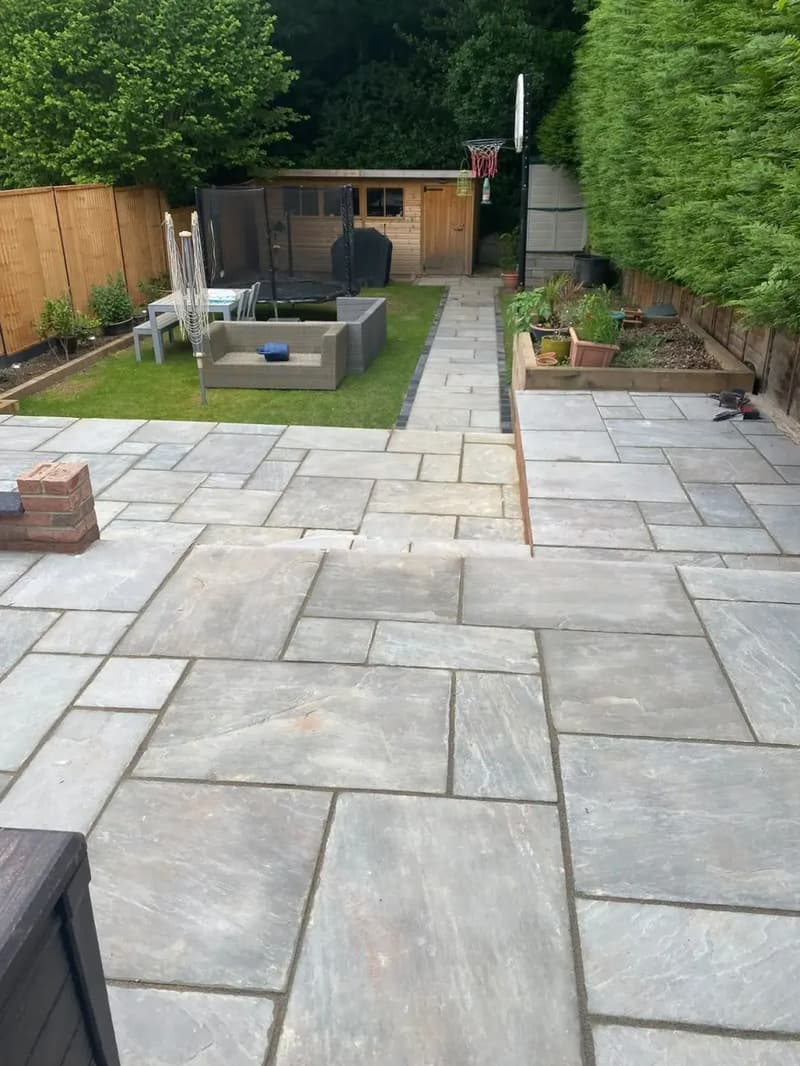
What sets the timescale
Area is the obvious factor, but it is rarely the only one. Getting materials in and spoil out can take as long as the paving itself if everything has to be barrowed through a house or along a narrow side passage. Gardens with easy rear or side access move along much faster.
Levels come next. A flat plot needs only gentle falls, whereas a sloping one may call for retaining edges, steps or a raised section, each of which adds its own building time. Breaking out an existing patio or concrete base adds a day or more of demolition and disposal before the new work can begin.
Finally, the material itself makes a difference, mainly in how it is cut and jointed, which is covered further down.
Stage by stage
Every patio Daniel lays follows the same basic order described on our patios page. Knowing the stages helps explain why the first couple of days can look slow: most of the important work ends up hidden underneath.
- Marking out the shape and agreeing finished heights against doors and damp-proof courses
- Digging out to the right depth and removing the spoil from site
- Building the sub-base in layers, compacting each one
- Setting the falls so rainwater runs away from the house
- Bedding each slab and checking line and level as it goes
- Cutting around edges, drains and corners
- Jointing and cleaning down
Porcelain and sandstone take different handling
Porcelain is dense and hard, so cuts take longer and need the right blade. Its regular shape means joints have to be very consistent, and slabs are usually primed on the back to bond properly. Sandstone is quicker to cut but its natural thickness varies, so each piece is bedded a little more individually to sit flush with its neighbours.
Neither is dramatically slower overall, but the difference shows up on patios with lots of cuts or curves. Our porcelain vs sandstone guide compares the two, and there are separate pages on porcelain patios and Indian sandstone patios.
Patios
- Porcelain, sandstone and natural stone patios
- Compacted sub-base built in layers
- Falls for drainage away from the house
Weather and why some days pause
Groundwork can carry on through light drizzle, but heavy rain turns excavations to mud and makes compacting the sub-base less effective. Mortar should not be laid onto frozen ground or left exposed to frost before it has set, so cold snaps can hold up the bedding stage.
Jointing is the most weather-sensitive step. Many jointing products need a dry spell to go in cleanly, so a finished-looking patio may sit for a day waiting for the right conditions. That pause protects the final result.
When you can walk on it and use it
Light foot traffic is usually fine fairly soon after the slabs are bedded, but mortar keeps gaining strength for some time afterwards. Heavy furniture, hot tubs, planters and barbecues are best kept off until the bed and joints have properly cured.
Follow the guidance given for the specific jointing product used, and leave any pressure washing until well after that. Daniel will tell you when the patio is ready for normal use once the job is finished.
Patios within a bigger renovation
When a patio is one part of a larger project, the order of work matters more than the speed of any one stage. Groundwork and levels across the whole garden come first, then hard landscaping, then fences, and lawns last so they are not trampled. Read how that sequence works on our garden renovations page.
For a sense of what affects the budget alongside the timescale, see the patio cost guide. To plan your own patio, get in touch or call 07841 510110.
Want a professional to handle it?
Tell us what you have in mind and Daniel will talk it through with you.
07841 510110Step 1 of 3
What would you like help with?
Frequently asked questions
Do I need to be home while the patio is laid?
Not all the time. Access to the garden, water and somewhere to wash tools is helpful, and being around at the start to agree the layout and heights is useful.
Can you lay a patio in winter?
Yes, in suitable weather. Work stops on frozen or waterlogged days, so winter jobs can take a little longer overall.
When can I put furniture on it?
Light chairs are often fine soon after, but heavy items should wait until the mortar and joints have cured. Daniel will advise once the job is done.
Does removing an old patio add much time?
It adds a stage of breaking out and taking away the old paving and base. How long depends on the size and how solidly the old patio was built.
How long before I can jet wash new joints?
Give the joints plenty of time to cure and check the jointing product's guidance first. Many people find a soft brush and water is all a new patio needs anyway.
Related guides
Related services
Covering Southampton and Hampshire